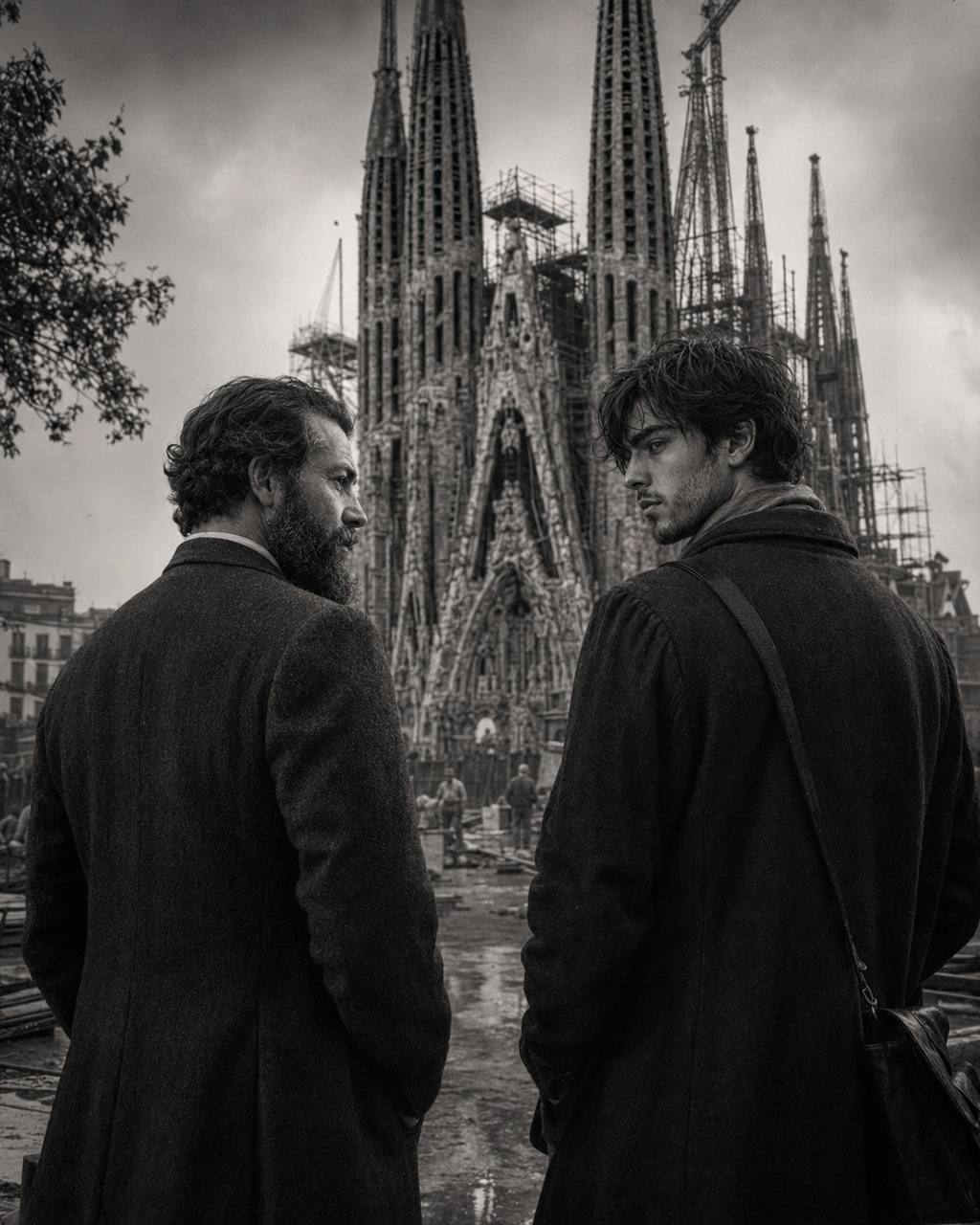
Today, as the world once again turns its eyes toward Barcelona and the Sagrada Família – a structure rising above time, death, and human patience – it is impossible not to think of Antoni Gaudí.
One hundred years have passed since his death, yet the temple to which he devoted his life still speaks in his language: stone, light, silence, and lines that cannot be explained by architecture alone.
In the novel VITEZ, Sagrada Família is not merely a church. It is a node. A heart. A place where the visible and the invisible meet – and where Elian recognizes what Gaudí may have felt his entire life, but could never fully put into words.
There are structures built by hands.
There are structures built by faith.
And then there are those that seem as if time itself had been waiting to complete them.
Sagrada Família was never just a church.
In the world of the novel VITEZ, it is something deeper – a node, a heart, a passage, a place where beneath stone and light, lines meet that ordinary people cannot see. While the world observes one of Antoni Gaudí’s most famous works, the novel asks a quieter question: was Gaudí only building a church… or was he following something his entire life that even he could never fully understand?
In one of the key encounters, Elian watches the young Gaudí drawing spirals on stone. Not as an architect who already knows his plan, but as a boy who feels the signs along the way.
“What do they represent?” Elian asks.
“They are the paths I see in dreams. They lead to a place that does not yet exist.”
That moment opens an entire layer of the story. Gaudí is not shown only as a genius of architecture, but as a man through whom something older than himself is passing. His spirals are not only shapes. They are traces. Maps. Memories of the earth.
Later, when Elian speaks to him again, Sagrada Família is no longer only a future basilica.
“This is not just a church,” Gaudí says.
“No. This is a node. A heart.”
In that sentence lies the whole secret. In VITEZ, Sagrada is not only a place of prayer. It is a place of energy, passages, and invisible lines crossing beneath Barcelona. A place that draws those who wish to protect – but also those who wish to open doors that perhaps should never have been opened.
And there, the question that follows the entire story appears:
Was the Church protecting Gaudí?
Was it using him?
Or did it only partially understand what was being built before its eyes?
Elian knows more than he says. Gaudí feels more than he can explain. And between them stands a structure growing through decades, as if stone itself remembers what people forget.
Near the end of Gaudí’s life, when the years already carry their weight, Elian tells him something that sounds almost like a sentence:
“But… you know your eyes will not see its completion.”
Gaudí lowers his gaze.
“I know.”
In that short answer lies the sorrow of a man who knows he is building something greater than his own life. Something that will not belong only to him, but to time, to memory, and to those who come after.
Perhaps that is why Sagrada Família had to wait so long.
Perhaps some structures must not be completed until the world is ready to look at them.
In the novel VITEZ, Gaudí is not only building a church.
He is following the lines.
Elian understands them.
And Sagrada Família remains between them – as stone, prayer, and a gateway.
Leave a Reply